APPENDIX A
Compression and indexing
Chapter 3 followed a sliding window into attention; chapter 4 allocated blocks without explaining their compressed rows. Here we follow the other read path: completed compressed KV, a smaller index used to select rows, and the temporary state needed to produce the next row.
The question
If two token positions produce one compressed row, what happens when a prefill chunk ends after the first token? Can a later six-position verification step write all its inputs into a two-entry compression ring?
python3 labs/26_compression.py
C2 rows (before BF16/norm/RoPE): [('6', '8'), ('8', '3'), ('3', '5')]
Chunks [0,1), [1,4), [4,7): valid/reserved rows [(0, 1), (2, 2), (1, 1)]
Pending token positions: [6]
Six-position decode: ring 7 preserves every completed pair
Ring 6 corrupts first pair: ('42/5', '8')
Checks: 64 chunk partitions agree exactly; undersized ring fails
Default C2 state payload: 7 * 2 * 512 * 4 = 28672 bytes
Seven inputs produce three completed pairs and one pending input. Splitting the inputs into chunks of lengths 1, 3 and 3 does not change those pairs. A six-entry ring, however, lets the last new write overwrite the first pair’s old input. Seven entries preserve it. Compression reduces the completed cache; it still needs live state between steps.
Scope and order. We first explain the gated mean and its boundaries, then follow
V4Attention through the compressor and indexer to the final attention read. A second
experiment separates scoring, candidate restriction and address conversion. Finally, we account
for bytes and distinguish the objects shared across layers. The case is a sparse C2 layer that owns
its main KV and index-K, without YOCO compaction or CP sharding; later sections identify
where those other paths differ.
A.1 A pair is complete only at its boundary
There are two kinds of compression in this discussion. MLA compresses a feature vector, as
chapter 3 explained. C2 combines two token positions into one row. It does not halve the number
of channels in that row. C1 keeps one row per position. The released Compressor accepts
only ratios 1 and 2 and rejects the optional compress_overlap and use_ape settings
[87].
For latent component , the C2 operation over positions is
The score is
a learned gate;
is the projected latent. Each channel has its own weights over the two positions. This is not
attention over the whole context, nor an unweighted average. In v4_modules/mla_attn.py,
SoftmaxAPEGatedColumnParallelLora constructs an A projection for values and a Gate
projection for scores. Its name retains APE, although the runtime rejects that option. The
single-position C1 softmax is one, so C1 needs no Gate [87].
The first lab pair has values and . It substitutes positive integer weights and for the exponentials. The result is : the second token dominates channel zero, while the first dominates channel one. Fractions let us check this mathematical operation exactly. They do not reproduce floating-point exponentials or BF16 rounding.
The lab implements that mean with rational weights:
def compress(rows):
return tuple(sum(F(w[d]) * v[d] for w, v in rows)
/ sum(w[d] for w, _ in rows) for d in range(2))
The source reference reduces over positions, then casts the result:
result = (latent_slice * score_slice.softmax(dim=0)).sum(dim=0).to(torch.bfloat16)
kv_compressed[compressed_start + blk_id - qstart // compress_ratio] = result
The production wrapper makes the C1/C2 distinction explicit:
if self.kv_compress_ratio == 1:
assert projected_kv.dtype == torch.bfloat16 and state_cache is None
if input_metadata.mirror_cp_reverse_index is not None:
projected_kv = gather(projected_kv.contiguous(), input_metadata.mirror_cp_reverse_index)
return projected_kv
assert projected_kv.dtype == torch.float32 and state_cache is not None
score, latent = projected_kv.chunk(2, dim=-1)
C1 receives BF16 and no compression state. Its optional gather restores CP’s input ordering. C2 receives FP32 score/latent pairs and requires state. The following branch calls the prefill or decode helper with the same ratio. These helpers return BF16 rows before the compressor’s normalisation and RoPE.
A.1.1 Chunk boundaries and placeholder rows
Let be the first new token position and the exclusive end of a chunk. For ratio , the number of newly completed rows is
The prefill reference iterates exactly those compressed indices. If a pair began before , it reads that input from the state ring; otherwise it reads from the current projection. It subsequently retains recent score/latent pairs in the ring for later chunks [88].
For , no pair is complete. For , pairs and finish: position zero must survive the first chunk. For , only finishes. Position six remains pending. Lab 26 tries every choice of cuts between the seven inputs and compares the completed rows and pending suffix with processing the whole sequence.
Physical output shape is not the valid-row count. The prefill metadata reserves
rows per request, even
when . Its placeholder has
position zero and store slot ;
the reference compression output is zero-filled there. Decode instead reserves one output row per
query position, with zero output and no valid store slot for a position that does not complete a
group. The C++ builder implements these conventions in prepare_tensor_input_v4.cpp:46–91.
A placeholder is not an extra cached token [89].
A.2 Temporary state must survive speculative writes
A C2 cache row cannot replace the score and latent of an incomplete pair. The live ca_state
stores both, in FP32, with shape
The axis of length two is score versus latent, not K versus V. ca_cache holds completed
compressed KV in paged blocks. Their lifetimes and byte formats differ.
The decode reference writes every new position before computing completed rows. Its assertion states the required capacity:
compress_token = compress_ratio
state_cache_size = state_cache.shape[1]
assert state_cache.shape[1] >= compress_ratio + max_seqlen_q - 1
# store: each token writes to cache
for idx in range(total_q):
sidx = state_block_idx[idx].item()
cpos = (context_lens[idx].item() - 1) % state_cache_size
state_cache[sidx, cpos, 0, ...] = score[idx, ...]
state_cache[sidx, cpos, 1, ...] = latent[idx, ...]
# compute: check each token's position
kv_compressed = torch.zeros(total_q, dim, dtype=torch.bfloat16, device=score.device)
for idx in range(total_q):
abs_pos = context_lens[idx].item() - 1
if abs_pos % compress_ratio == compress_ratio - 1:
For a group of positions and up to new positions per state slot, retaining old inputs alongside all new inputs requires . This is the same write-before-read hazard encountered with SWA, applied to a different ring.
In the lab, position zero is old; positions 1 through 6 are written in one step. With , position six takes position zero’s slot before pair is read. With , no required input is overwritten. The incorrect first component becomes , rather than 6. No future position belongs in that pair, even though it has already been written to memory.
The cache engine derives its ring from the backtracking allowance, and separately decides whether an indexer needs its own state:
def _needs_index_state(attn_module: AttrDict) -> bool:
if attn_module.cfg.get("index_topk", 0) <= 0:
return False
index_cfg = attn_module.cfg.get("attn_index")
return index_cfg is None or not index_cfg.get("use_kproj", False)
@lru_cache(8)
def get_inference_compress_block_size(compress_ratio: int) -> int:
"""Compression ring plus rollback history; environment changes require clearing the cache."""
return compress_ratio + max(0, envs.DEEPINFER_MAX_BACKTRACKING_TOKENS - 1)
With the default nextn=5, the backtracking allowance is at least six. For C2 the default ring is
,
not the SWA ring’s 134. At dimension 512 its score/latent payload is
bytes
per owning layer per state slot. That excludes other state regions and any layout padding.
Rejecting a draft changes which positions are valid; it does not require clearing every byte, as
chapter 4 established.
A.3 One compressed result feeds two caches
The main attention module connects ownership to computation:
assert wait_projected_kv is not None
assert self.PackedWkv is not None
return self.PackedWkv.forward_store_kv_cache(
wait_projected_kv(),
kv_cache.ca_cache,
kv_cache.ca_state,
input_metadata,
return_pre_rope_kv=self.has_local_index,
)
The result forks after normalisation and before rotary position encoding. The main branch
applies RoPE, casts to the main cache format and writes ca_cache. A local indexer also needs
the normalised pre-RoPE latent:
cast_args=CastArgs.from_cache_format(cache_format),
out_args=KVCacheOutArgs(
kv_cache,
input_metadata.slot_mapping_store_ca[self.ratio_key],
out=pre_rope_kv,
out_stage="norm",
layout=cache_format,
),
)
return pre_rope_kv[:, 0] if pre_rope_kv is not None else None
out_stage="norm" identifies the retained stage. The surrounding call
supplies the compressed positions and RoPE parameters. For compressed row
, the C++ metadata
uses position ,
the beginning of its group, while a query keeps its original token position. Equal row numbers
therefore do not imply equal positional coordinates [89]. Figure A.1 shows where the two caches
separate.
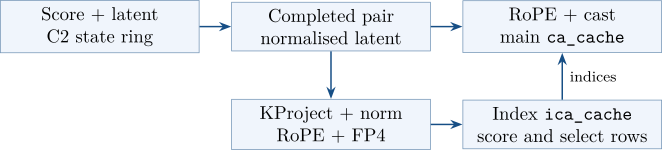
The index branch projects that latent to a smaller key. Its store method requires that no independent index compression state be present:
if not self.store_index_k:
return
assert index_k_input is not None
assert state_cache is None
index_k = self.index_k_module.forward_pre_norm(index_k_input)
norm = self.index_k_module.norm
fused_norm_rope_hadamard_cast_store_kvcache(
index_k,
norm_args=NormArgs(norm.weight, norm.variance_epsilon),
The model configuration selects KProject with attn_index.use_kproj=True. The cache
engine therefore leaves ica_state=None on this V4.1 path. The field remains in the generic
interface for a separately compressed index path. It is not a second accumulator that every sparse
layer allocates. ica_cache still exists: absence of live index state does not mean absence of
completed index keys [90].
This is a model-driven requirement. A block allocator alone cannot decide that the index keys derive from the main compressed latent, that C1 needs no pending pair, or that a consumer layer reuses another layer’s cache. Those decisions come from the model configuration and its runtime adapters.
A.4 Select rows, then translate their addresses
An indexer makes a cheaper scoring pass before main attention. The runtime describes its score for key as
These are learned index queries and head weights, not the main attention softmax probabilities. ReLU
means .
DeepGEMM computes the logits; DeepSelect supplies the imported topk. Their kernel internals
remain outside this walkthrough [90].
python3 labs/27_indexing.py
Scores: [2, 6, 3, 0, 300] | valid prefix: 4
Top-2 over valid rows: [1, 2]
Candidate block scores: [6, 3] | retained block: 0
Top-2 within retained block: [0, 1]
One valid row, three output slots: [0, -1, -1]
Prefill at gathered offset 10: [11, 12]
Decode logical rows: [1, 2, 4, -1] -> physical slots: [29, 30, 8, -1]
The lab uses two query heads, and , with weights 1 and 2. Key scores 6, while scores 3. The fifth key would score 300, but it is outside the valid prefix. The chosen rows are 1 and 2, not 4. The calculations omit projection, RoPE and quantisation and use a stated index-based tie rule; they do not reproduce the device top-k implementation.
The teaching score uses ordinary integer arithmetic:
def score(key):
return sum(w * max(0, sum(a * b for a, b in zip(q, key)))
for w, q in zip(WEIGHTS, Q))
A.4.1 Validity comes before ranking
A query at original position can see completed compressed rows. The metadata supplies that count per query:
for (int r : args.sparse_compress_ratios) {
py::str name = std::to_string(r);
auto klen = get_or_create_tensor(klen_dict, has_out, name, {total_q}, torch::kInt32);
auto p_klen = klen.mutable_data_ptr<int32_t>();
i_q = 0;
for (auto p_seq : seq_metadata_list) {
for (int32_t j = p_seq->seqlen_k - p_seq->seqlen_q; j < p_seq->seqlen_k; ++j, ++i_q) {
p_klen[i_q] = (j + 1) / r;
}
}
TORCH_CHECK_EQ(i_q, total_q);
For C2, query zero sees no completed row; query one sees row zero; query two still sees only row zero. The most recent unpaired token remains available through the layer’s SWA path. A large score in an unwritten or future slot must not enter the selection.
Decode passes an explicit valid range to top-k:
topk_index = topk(
p_sum,
self.topk_tokens,
sorted=False,
end=topk_lens, # We must pass `end` to the topk kernel since OOB p_sum is not cleaned.
indices_type=torch.int32,
sorted_index=True,
idx_oob_fill_value=-1,
return_value=False,
)[1]
if candidate_blocks is not None:
restore_candidate_indices_inplace(topk_index, candidate_blocks, candidate_block_size)
end excludes invalid score storage, whose contents need not have been cleared.
idx_oob_fill_value=-1 fills unused output lanes. The request for sorted_index=True concerns
index ordering, not decreasing score order. The lab returns a set of chosen rows in index order
and checks its total score against all pairs of valid rows. It also checks empty and undersized
ranges.
A.4.2 Candidate blocks are another restriction
Some layers first reduce index scores by candidate block, using a maximum, and select blocks for later layers to search. This grouping is distinct from the allocator’s 128-token page. In the lab, two index keys form a candidate block: block scores are 6 and 3. Retaining only the first block changes token top-2 from to . Thus top-k within candidates need not equal top-k over all valid keys, even with exact arithmetic.
The runtime’s candidate consumer accepts block sizes 8 or 16 in compressed-row units and
imposes further width constraints; the lab’s block size two and single retained block are
deliberately smaller teaching values. A source layer fills block_candidate_idxs; a
consumer computes logits only within that set, then restores compact candidate offsets to
logical row indices. Comparing this model with unrestricted attention would require a
model-quality check, not merely equality between two implementations of restricted top-k
[90, 91].
Prefill limits the size of its intermediate score matrix with compute_chunk_size. It derives
the row width from either the full compressed context or the candidate set, applies the memory
budget, rounds to multiples of eight and caps the chunk at 8,192 queries. That is a temporary
logit-storage budget, not the number of keys finally selected.
A.4.3 The same logical row has two physical representations
For prefill, _load_prefill_kv gathers keys into a concatenated sequence buffer. Top-k adds the
request’s ks offset, or restores candidate indices with that offset. With base 10, logical rows 1 and
2 become 11 and 12.
Decode keeps paged storage. With original-token positions per allocator block, a ratio- cache has compressed rows in that block. Logical row maps to
The released indexer performs this conversion after candidate offsets have been restored:
# topk outputs the logical index of the compressed token within the seq, which is converted in place into the kvcache
# physical slot through block_tables (-1 is kept)
convert_kv_index(
topk_index.unsqueeze(1),
compressed_block_size,
topk_lens.unsqueeze(1),
input_metadata.block_tables,
)
return topk_index
The lab’s smaller page has , with block table . Rows 1, 2 and 4 map to slots 29, 30 and 8. Its last lane represents padding and remains . The CUDA conversion checks the lane’s position against the valid count; callers must not put an arbitrary invalid index in a lane declared valid. The lab’s sentinel guard is a teaching convenience, not a transcription of that kernel [92].
Finally, main attention reads the SWA and compressed branches together:
if self.use_swa:
attn_kv_args = dict(
key_cache=kv_cache.swa_cache,
indices_in_kvcache=kv_swa_index,
key_cache_extra=kv_cache.ca_cache,
indices_in_kvcache_extra=kv_ca_index,
index_length_extra=dense_index_len,
)
The following decode_mla_mqa_sparse call goes to FlashMLA. It receives ca_cache, not the
smaller ica_cache, as its extra key/value storage. This completes the path from compression
state to the actual attention read [93].
A.5 Count rows, payloads and owners separately
C2 halves the completed row count relative to C1. Low precision separately changes each row’s byte count. The index format specifies 128 FP4 elements and one one-byte UE8M0 scale per 32 elements:
FP4_INDEX_KV_FORMAT = KVCacheFormat(
quantized_dtype="e2m1",
quantized_elements=128,
elements_per_sf=32,
bf16_elements=0,
do_cast=False,
sf_format="ue8m0",
note="V4/V41, index kv.",
)
The same file describes main formats. Here E2M1 and E4M3 name floating-point encodings; UE8M0 is the unsigned exponent scale encoding. The relevant accounting is payload bits plus the stored scales:
| Cache format | Data plus scales | Bytes per row |
| Main/SWA FP8 | 528 | |
| Main FP4 | 288 | |
| Index FP4 | 68 |
The main FP4 format uses one E4M3 scale per 16 values; its scale format differs from the index format. Main/SWA caches interleave data and scales within each row, whereas the index cache uses block-wide data and scale sections. The 68-byte figure is a logical per-row byte budget, not a claim that each physical index row is laid out as 64 immediately adjacent data bytes followed by four scales. Alignment and shared ownership affect total allocation [24, 90].
A 128-position C2 block has 64 completed-row slots. An owning main cache uses payload bytes with FP8, or 18,432 with FP4; an owning index cache uses . The cache engine rounds regions to its alignment requirements and does not allocate another copy for a sharing consumer. The live 28,672-byte compression-state example is a separate per-request allocation. These equations explain chapter 4’s rows without claiming a measured reduction in model error or end-to-end latency.
A.6 Sharing has several meanings
Chapter 9 separated YOCO’s shared hidden state from segmented sharing. Here are the latter’s distinct objects:
Map | Reused object | Work a consumer may still do |
| Main compressed KV | Project index-K or choose new indices |
| Index keys | Score its own queries and choose indices |
| Selected top-k indices | Main attention using its queries |
| Candidate block set | Token top-k within those blocks |
For a four-layer teaching example, main-KV sources might be , index-K sources , and index sources . Each finer segment lies inside a coarser one. An index-K source cannot project from a main KV belonging to a different segment. The topology checks this refinement:
@staticmethod
def _validate_map_refines(fine_name: str, fine: list[int], coarse_name: str, coarse: list[int]) -> None:
# Under the segmented assumption, coarse[fine[l]] == coarse[l] is equivalent to every segment of fine
# falling inside a single segment of coarse.
for layer_id, fine_src in enumerate(fine):
assert coarse[fine_src] == coarse[layer_id], (
f"shared {fine_name} map must refine {coarse_name} map: layer {layer_id} -> {fine_name} source {fine_src}, "
f"but {coarse_name} sources differ: {coarse[layer_id]} != {coarse[fine_src]}"
)
This is only an example of valid map nesting, not a replacement model configuration. Other
checks require compatible layer settings, preceding source layers and a fresh KV source at the
YOCO boundary. The topology is static; CrossLayerRuntime carries pre-RoPE KV,
loaded index keys, indices and candidate data from source to consumer during a forward
call. Under YOCO compaction, full-layout main/index KV may already have been
written, so the compact query path skips those stores. Chapter 9 covered that boundary
[91, 93].
A.7 Experiments to try next
The labs check rational compression, state lifetime and index/address arithmetic; they do not establish accelerator equivalence or acceptable generation quality. The released compression tests compare device outputs with a tensor reference and check state tensors. We inspected those assertions without running the tests.
- Change the first pair’s weights so each channel has equal weights. Which outputs become ordinary averages? Keep the chunk checks unchanged.
- Explain why a zero-valid-row prefill chunk still reserves an output row. Which metadata prevents that placeholder from becoming a real cache entry?
- For C2 with at most four new positions, derive a sufficient compression ring size and construct the write that would break a smaller ring.
- Give an example where restricting candidates preserves token top-k, and one where it changes it. What would a model-quality evaluation need in addition?
- Trace one selected compressed row through
ica_cache, top-k, the block table andca_cache. Which steps change values, and which only change addresses or the set of rows read?
The reading path distinguishes pending state, completed KV and selection keys. Use those distinctions to locate the next reader of a row and check its validity.