CHAPTER 05
Choose the next batch
A free block answers whether a request can own more memory. It does not answer whether that request should run next. One user has submitted a long document; another wants a short answer; a third is already receiving tokens. They compete for computation as well as storage.
The question
If we split a long prompt into smaller pieces, will short requests get their first token sooner? What should happen when the next step needs memory that another request owns?
5.1 A smaller chunk is an opportunity to choose
Chapter 1’s batching experiment gave each active request one token per round. Now give the scheduler prompt work and arrivals. Request A arrives at time 0 with 12 prompt positions. B and C arrive at time 3 with two each. A step processes one request’s prompt, or part of it. Give a step with positions the assigned duration : one unit of overhead plus one per position. The first output arrives when the prompt finishes. This experiment isolates prefill; it does not schedule subsequent decode tokens.
python3 labs/11_chunks.py
Compare three rules. First, finish each prompt in arrival order, also called first in, first out (FIFO). Second, allow at most four positions per step but put an unfinished request back at the front. Third, use the same four-position limit and put it at the back, behind arrivals seen during that step. Predict which rule helps B before reading the output.
Whole prompts, FIFO (budget 12)
   0->13: A q=12 waiting=['B', 'C']
  13->16: B q= 2 waiting=['C']
  16->19: C q= 2 waiting=[]
  first-token delays: A=13, B=13, C=16
  work=16 positions; steps=3; finish=19
With whole prompts, A occupies time 0–13. B finishes at 16, so its first-token delay is . Now cut A into chunks, keeping its continuation at the front:
Chunks, continuation at front (budget 4)
   0-> 5: A q= 4 waiting=['A', 'B', 'C']
   5->10: A q= 4 waiting=['A', 'B', 'C']
  10->15: A q= 4 waiting=['B', 'C']
  15->18: B q= 2 waiting=['C']
  18->21: C q= 2 waiting=[]
  first-token delays: A=15, B=15, C=18
  work=16 positions; steps=5; finish=21
The chunks create boundaries at 5 and 10, but the scheduler chooses A again at both. B’s delay rises to 15 because A now pays the overhead three times. Moving the continuation to the back changes who runs at those boundaries:
Chunks, continuation at back (budget 4)
   0-> 5: A q= 4 waiting=['B', 'C', 'A']
   5-> 8: B q= 2 waiting=['C', 'A']
   8->11: C q= 2 waiting=['A']
  11->16: A q= 4 waiting=['A']
  16->21: A q= 4 waiting=[]
  first-token delays: A=21, B=5, C=8
  work=16 positions; steps=5; finish=21
The third rule uses those boundaries to change requests. At time 5 the queue is B, C, A. B finishes at 8, five units after its arrival. C finishes at 11, eight units after its arrival. A pays for their earlier answers: its own first token moves from time 13 to 21. The queue operation responsible for the difference is small:
admit() # Arrivals during this chunk precede a rotated continuation.
if remaining[name]:
if rotate:
waiting.append(name)
else:
waiting.appendleft(name)
else:
first[name] = now
All three runs process 16 positions. The chunked runs take five steps instead of three, so their total duration is 21 rather than 19. Smaller chunks have changed latency and overhead without reducing the useful work. Chapter 2’s distinction between work and elapsed time applies here too. Figure 5.1 draws the three runs.
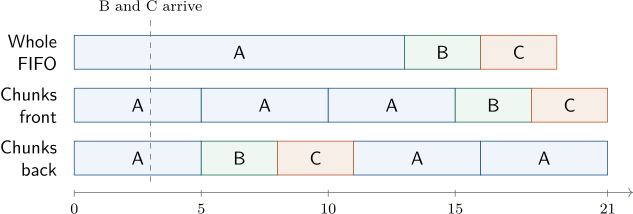
labs/11_chunks.py. Widths show assigned time, including
one overhead unit per step. Only the bottom policy uses a chunk boundary to let B and C
overtake A.
Chunk size and queue order are separate decisions. A short step creates a point at which other work could run. Whether it does depends on what the scheduler chooses there. The rotation rule is a teaching alternative; we will now inspect where DeepInfer actually puts an unfinished prompt.
5.2 Follow a prompt through the scheduler
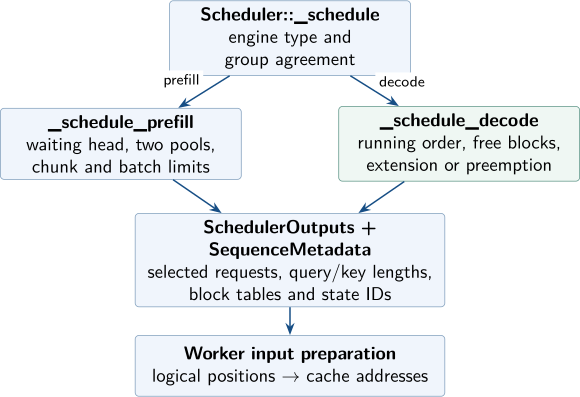
In chapter 1, LLMEngine.step called the C++ scheduler and passed its metadata to
the worker. Open that scheduler box. It makes three decisions in sequence: choose
a kind of step, choose requests that fit, then describe the positions that the worker
will evaluate. The block and state managers from chapter 4 participate in the second
decision.
The queue names have a useful historical comparison. vLLM v0.6.3 keeps waiting, running
and swapped queues of sequence groups (vllm/core/scheduler.py, lines 340–348). Its
preemption path can either discard cached progress for recomputation or swap blocks out for later
recovery [13]. DeepInfer’s C++ scheduler keeps waiting, running and prompted. In
this version, only fork_seq adds requests to prompted (scheduler.hpp, line 1118);
lines 581–618 handle their admission to decode. Although the SWAPPED status name
remains, this scheduler has no corresponding swapped queue or swap branch in _preempt
[37, 6].
We use that fixed vLLM release as a comparison, not an identified fork point. The familiar waiting/running distinction is only the starting point. Follow DeepInfer’s rank-wide step-type votes and its separate in-flight counts below: they determine what a request may do before the preceding device result is known. Figure 5.2 places these decisions on the request path.
5.2.1 Choose prefill or decode
DeepInfer’s released scheduler distinguishes three engine types. A PROMPT engine runs the
prefill path; a COMPLETION engine runs the decode path. A NORMAL engine can do either
(scheduler.hpp, lines 288–295). A normal engine chooses one kind for each step. It
does not build a batch mixing prompt chunks and decode rows in these two paths
[37].
That choice also involves other participants. A data-parallel rank is one participant with its own request batch in a cooperating group. The ranks must agree on the kind of step. Detailed distribution belongs to chapter 7; here the consequence is that a non-empty local queue cannot decide alone.
bool is_any_point = (decode_step != 0) && (decode_step % prefill_any_attempt_interval == 0);
bool is_all_point = (decode_step % prefill_attempt_interval == 0);
if (!is_any_point && !is_all_point) {
return _schedule_decode(acquire);
}
bool want = (get_gpu_cache_usage() <= GPU_CACHE_PREFILL_WATERMARK) && _has_prefill_waiting();
At an ALL attempt, every rank must want prefill; at an ANY attempt, one is enough. Lines
315–319 implement the votes. A rank wants prefill only if its cache usage is at or below the
watermark and the head of its waiting queue is schedulable. The default intervals are 70 and 100
decode steps respectively, from environ.py, lines 174–178. An ANY point takes precedence when
the two coincide. A prefill step resets decode_step to zero, which is another ALL attempt point
[30, 37].
Agreement to try is not admission. After trying, the ranks vote again to check whether any produced a prefill result. If all attempts returned no work, they fall back to decode (lines 328–340). The source comment explains why: an empty prompt step would reset the counter, invite another unsuccessful attempt and prevent running requests from making progress. The ANY interval therefore offers an opportunity for isolated prefill work; it is not a wall-clock latency guarantee or a promise that memory will be available.
5.2.2 The head of the queue must fit
_schedule_prefill examines waiting.front(). For a fresh request, it checks the prompt length
and asks whether both pools can provide the storage required by get_num_blocks. Chapter 4
established that this reserves blocks for the whole prompt, even when computation will be
chunked.
auto can_allocate = _can_allocate_with_state(seq->get_num_blocks());
if (can_allocate == AllocStatus::LATER) {
break;
} else if (can_allocate == AllocStatus::NEVER) {
LOG_WARN("Input prompt ({} tokens) is too long and "
"exceeds the capacity of block_manager",
num_prompt_tokens);
seq->schedule.status = SequenceStatus::FINISHED_IGNORED;
ignored_seqs.push_back(seq);
waiting.pop_front();
continue;
}
The difference between break and continue is a scheduling policy. LATER leaves the
request at the head and stops this pass. A smaller request behind it is not tried. This is
head-of-line blocking: work that could fit waits behind work that cannot yet fit. NEVER marks
the request ignored, removes it and tries the next one. It cannot become runnable by
waiting.
For example, suppose three blocks are free. The head needs four and the next request needs
one. If the pool can eventually provide four, the head receives LATER and neither request is
admitted in this pass. Choosing to skip the head would use the free memory now, but
repeated skips could keep a large request waiting indefinitely. The released path chooses to
stop; the code establishes that choice without establishing which policy is best for a
service.
Two other limits follow (lines 440–449). The scheduler limits the number of requests alongside
those already running, and subtracts each selected request’s whole history length from
prefill_sum_seqlen_k_remain. Despite the name, this second check does not charge only the
current chunk’s key length. It is separate from the query-position budget below. A request can
pass the storage check and still fail one of these limits.
5.2.3 Choose how many positions to evaluate
Chunking is off by default: EngineArgs.chunked_prefill is False in deepinfer/engine/arg_utils.py,
line 42. The shared example setup enables it in examples/_config.py, line 120, unless the
caller overrides that setting. The chunked paths below assume it has been enabled
[39, 17].
The unsatisfied prompt work is get_len() - cache.num_tokens. The scheduler first caps
that work by the remaining query budget:
if (seq_workload > (max_num_batched_tokens - num_batched_tokens) / cp_align * cp_align) {
new_workload = std::min(seq_workload, (max_num_batched_tokens - num_batched_tokens) / cp_align * cp_align);
seqlen_q = new_workload;
TORCH_CHECK(
seqlen_q < seq_workload, "_schedule: is_chunked must be true:, seqlen_q:", seqlen_q, " seq_workload: ", seq_workload);
}
Let be max_num_batched_tokens,
the positions already
charged to this batch and
the alignment. The available allowance here is
For example, with ,
and
, only
four of the seven remaining positions are available to the next chunk. The constructor sets
cp_align to 1 for one context-parallel participant, or twice the group size otherwise
(line 90). Context parallelism divides context computation across devices; Appendix B
shows how its ranks are grouped and how each sequence is split between them. For
this chapter, alignment means that useful positions and charged positions need not
match.
The cap is not the final chunk size. Lines 477–510 respect explicit checkpoints, move boundaries away from the inside of an image, check whether chunking is enabled and enforce a minimum chunk length. Once the chunk passes those checks, the scheduler commits the decision:
num_batched_tokens += (seqlen_q + cp_align - 1) / cp_align * cp_align;
TORCH_CHECK(seq->schedule.status == SequenceStatus::WAITING, "status ", int(seq->schedule.status));
if (seq->cache.block_table.empty()) {
acquire.allocate_seq(*seq);
}
if (!is_chunked) {
num_curr_seqs += 1;
seq->schedule.status = SequenceStatus::RUNNING;
allocate_mtp_info_slot(*seq);
}
The first line charges positions for useful queries. Five queries at alignment four cost eight budget positions. This is an accounting rule, not a claim that every padded position produces an output token.
The fresh request now owns blocks and a state slot. It enters the selected list and
leaves waiting. If this is only a partial prompt, its status stays WAITING; if it is the
final chunk, its status becomes RUNNING. Status is not queue membership: a partially
processed request can temporarily be outside the waiting queue while its chunk is in
flight.
When process_outputs handles an unfinished chunk, it puts the request back at the
front:
TORCH_CHECK(seq_ptr->schedule.status == SequenceStatus::WAITING,
SPRINT_VARS(
"In process_outputs, should be waiting", seq.cache.num_tokens, seq.input.tokens.get_len(), seq.get_nextn_len()));
waiting.push_front(seq_ptr);
That is the front-return rule from the experiment, not its rotation rule. Real execution adds
overlap, group agreement and the possibility of selecting several prompts in one step, with a limit:
a NORMAL engine stops selecting requests as soon as it selects an unfinished chunk (lines 543–545).
That chunk is therefore the last request selected in the step. Returned to the front after
processing, it again precedes later arrivals. The experiment’s times do not describe this engine,
but these two queue operations explain why chunking alone does not let a later short prompt
overtake a long one.
5.2.4 Prefill can keep decode waiting
Combine that return to the front with the step-type rule. The worker processes a prompt step’s
outputs before returning, even with ZOS enabled (worker.py, lines 101–102 and 182–187). An
unfinished A is therefore back at the head before the next scheduling call. Since prefill reset
decode_step to zero, that call is another ALL attempt. With one rank, prefill can continue
while the head remains schedulable, cache usage is at most the 0.9 watermark and
the admission checks succeed. There need not be a decode step between A’s chunks
[7, 37].
With several ranks, consecutive ALL attempts require every rank to want prefill.
At an ANY attempt, however, some ranks may have no local work. At either kind of
attempt, a rank that wanted prefill may still admit nothing, for example because its
head request needs blocks that are not free. If another rank has scheduled prefill, such
ranks execute an empty prompt step (scheduler.hpp, lines 332–340); their running
decode requests do not advance either. During these prompt steps the engine schedules
no new decode work. It may still deliver results from an earlier decode step, which
the worker post-processes before sampling the current step. Once those results are
drained, waiting for the next decode step can lengthen chapter 2’s inter-token intervals.
This consequence follows from the inspected control flow; it is not a measured engine
result.
The scope matters. NORMAL serves offline or combined prefill/decode execution. The
production Q&A describes separate prefill and decode instances, the separate roles represented by
PROMPT and COMPLETION in the released scheduler. The repeated choice between prefill and decode
described here belongs to the normal engine, not that separated production architecture
[2, 37].
5.2.5 A chunk becomes positions and addresses
Trace a text-only request with 300 prompt tokens. Use a normal engine with chunking enabled, a query budget of 128, alignment one, no prefix hit and no draft positions. Assume all other limits permit admission, enough memory is free and each previous chunk has been processed before the next is scheduled.
At its first admission, get_num_blocks asks for
blocks.
The allocator also gives it a state slot. All three chunks keep those allocations:
| Chunk | Cached before | Query length | Key length | Query positions |
| 1 | 0 | 128 | 128 | 0–127 |
| 2 | 128 | 128 | 256 | 128–255 |
| 3 | 256 | 44 | 300 | 256–299 |
Scheduler::schedule builds a metadata record for each selected request. Its key length is
the processed count plus in-flight positions plus this step’s query length (lines 696–707). Our
trace has no in-flight positions from another step. The SequenceMetadata constructor
takes the block-table reference and state ID from the sequence (sequence.hpp, lines
374–381).
One downstream consumer makes the connection to chapter 3 explicit. The prefill input builder converts those lengths and that state ID into SWA write addresses:
auto slot_mapping_store_swa = get_or_create_tensor(result, has_out, "slot_mapping_store_swa", {total_q}, torch::kInt32);
auto p_slot_mapping_store_swa = slot_mapping_store_swa.mutable_data_ptr<int32_t>();
int32_t i_q = 0;
for (auto p_seq : seq_metadata_list) {
for (int32_t j = 0; j < p_seq->seqlen_q; ++j, ++i_q) {
if (p_seq->seqlen_q - j <= swa_block_size)
p_slot_mapping_store_swa[i_q] = p_seq->state_id * swa_block_size + (p_seq->seqlen_k - p_seq->seqlen_q + j) % swa_block_size;
else
p_slot_mapping_store_swa[i_q] = -1;
}
}
TORCH_CHECK_EQ(i_q, total_q);
Within a chunk, query is at logical position . For the second chunk, gives . In state slot 2 with the default ring length 134, its destination is ; query wraps to . All our chunks fit within the ring. For a chunk longer than the ring, the condition keeps only its last ring-length positions; earlier destinations receive . Chapter 3 explained why prompt attention has a temporary input and reads the old cache before writing these final rows [38].
The scheduler has therefore chosen more than request names. It has chosen a range of logical positions, a budget charge and the storage through which the worker will address those positions.
5.3 When running requests exhaust the pool
Admission is not the last memory decision. A request already producing tokens can need another block. Preemption means taking resources away from such a request so another can proceed. It may suspend work for later recovery or terminate the request. DeepInfer has both outcomes.
Run a second experiment:
python3 labs/12_preempt.py
The pool has 19 usable blocks, each with four positions. A, B and C own all of them. B and C have just generated a token beyond the end of their last block; that token is in their history but has no cache row yet.
| Request | History length | Output length | Processed | Blocks owned |
| A | 20 | 8 | 19 | 5 |
| B | 45 | 2 | 44 | 11 |
| C | 13 | 4 | 12 | 3 |
Which request should give up its blocks? B owns the most, but it has generated the least
output. These are different possible priorities. The experiment uses the inspected decode ordering,
then applies each of the three branch conditions in _preempt:
stop=False, A.so_status=0
  output order: [('A', 8), ('C', 4), ('B', 2)]
  candidate=B; victim=A; blocks A=5, B=11, C=3
  A: WAITING, processed=0, blocks=[], state=-1
  waiting=['A', 'D'], ignored=[], free=[3, 2, 1]
  history retained=True; scheduled=['B', 'C']

stop=True, A.so_status=0
  output order: [('A', 8), ('C', 4), ('B', 2)]
  candidate=B; victim=A; blocks A=5, B=11, C=3
  A: FINISHED_PREEMPTED, processed=19, blocks=[], state=-1
  waiting=['D'], ignored=['A'], free=[3, 2, 1]
  history retained=True; scheduled=['B', 'C']

stop=False, A.so_status=1
  output order: [('A', 8), ('C', 4), ('B', 2)]
  candidate=B; victim=A; blocks A=5, B=11, C=3
  A: FINISHED_PREEMPTED, processed=19, blocks=[], state=-1
  waiting=['D'], ignored=['A'], free=[3, 2, 1]
  history retained=True; scheduled=['B', 'C']
A loses five blocks. B and C take one each, leaving three free. In the first run A goes ahead of D in the waiting queue and loses its processed cache count. Its 20-token history survives. In the second run a stop flag makes A finish; in the third an active structured-output status does so even though the stop flag is false. All three return A’s blocks and state slot. The nonzero processed count printed for a finished A is no permission to read its freed storage.
5.3.1 Read the comparator and both ends of the queue
After admitting ready forks from prompted, the decode scheduler sorts running and selects
requests:
std::sort(running.begin(), running.end(),
[](const SequencePtr &a, const SequencePtr &b) { return a->get_output_len() > b->get_output_len(); });
scheduled.reserve(max_seqs);
size_t l = 0, r = running.size();
while (l < r && scheduled.size() < max_seqs) {
auto &seq = running[r - 1];
while (!block_manager->can_allocate_single_nolock() && r - l > 1) {
auto victim_seq = running[l];
_preempt(victim_seq, ignored_seqs);
l += 1;
}
if (block_manager->can_allocate_single_nolock()) {
_append_slot(*seq);
scheduled.push_back(std::move(seq));
} else {
_preempt(seq, ignored_seqs);
}
The comparator orders output lengths from greatest to least: A, C, B in the experiment. The
candidate is running[r - 1], so B goes first. If no block is free, the victim is running[l], so A is
preempted. Output length is already generated work, not remaining answer length or allocated
memory. Nothing here can tell that B will finish soon.
Read two nearby comments with that trace in mind. The decode scheduling comment says it
preempts the shortest output (line 557, author’s translation), while the body takes a victim from
the longest-output end. In sequence.hpp, line 56, the comment on the preemption finish reason
says that the request occupying the most KV cache is forcibly terminated (author’s translation).
The example separates those quantities: A is selected although B owns more blocks. The control
flow also permits recomputation. These comments do not fully describe the inspected
policy.
There is another constraint in the body: even a candidate whose existing tail has space is
considered only after the free-block check succeeds. _append_slot might then allocate nothing.
Thus “my table is large enough” does not by itself guarantee that this loop will schedule the
request. If no other victim remains and no block becomes free, it preempts the candidate itself.
Pins from chapter 4 matter here: freeing one request does not necessarily free any shared
block.
After choosing survivors, the scheduler sorts them again, this time by total history length, before building per-request query lengths (lines 648–657). The first sort determines who survives memory pressure; the second determines the batch order passed onwards. Ties in these comparators do not establish an arrival-order guarantee [37].
5.3.2 Termination and recomputation are different contracts
The default depends on the entry point. Unless the caller supplies a value, offline LLM sets
stop_preempted_request to False (llm.py, line 68), giving the recovery policy used in the lab’s
first run. Construction paths that retain the EngineArgs default instead use True
(arg_utils.py, line 40), which requests termination. The structured-output guard still applies in
either case [4, 39].
The preemption branch first asks whether it is allowed to recover this request:
const bool so_blocks_recompute = seq->structured_output.status != 0;
if (stop_preempted_request || so_blocks_recompute) {
if (so_blocks_recompute && !stop_preempted_request) {
LOG_WARN("Request {} is preempted and stops: structured output (so_status {}) can not be recomputed.",
seq->request.request_id, seq->structured_output.status);
} else {
LOG_WARN("Request {} is preempted and stops.", seq->request.request_id);
}
seq->schedule.status = SequenceStatus::FINISHED_PREEMPTED;
free_seq_nolock(*seq);
ignored_seqs.push_back(seq);
} else {
LOG_WARN("Request {} is preempted and will be recomputed.", seq->request.request_id);
Structured output constrains generation to an allowed form, such as a grammar, and carries
state beyond token IDs. The actual guard is structured_output.status != 0; it is not a test of
whether the original request merely supplied a grammar. The log message says this state cannot
be recomputed by the present path. Sequence::reset_for_recompute helps us see the
boundary:
void reset_for_recompute() {
cache.reset_for_recompute();
schedule.reset_for_recompute();
mtp.reset_for_recompute();
}
The helpers reset the current and previous processed counts and the SWA valid start; they
clear both in-flight counters and selected draft state. They do not erase the token history,
sampling configuration or structured-output matcher (sequence.hpp, lines 134–142, 223–227 and
258–261). A recovery path would have to establish a compatible matcher state too. That is an
inference from the state separation, not a claim that replaying a grammar is impossible
[6].
In the recovery branch, line 783 calls this reset. Its Chinese comment points to the reset helpers as the inventory of rolling state (author’s translation). The remaining operations put the request back and return its resources:
waiting.push_front(seq);
seq->schedule.status = SequenceStatus::WAITING;
free_seq_nolock(*seq);
}
When A returns to prefill in our case, its history still has 20 tokens but its processed count is zero. The prompt path therefore sees 20 positions of work, including tokens already generated. It rebuilds state for that history; it does not erase the eight output tokens and start a new answer. This recovery adds computation and delay. It does not by itself prove bitwise identity after replay; chapter 10 separates the relevant correctness contracts.
In the vLLM comparison, an unspecified preemption mode selects recomputation when
get_max_num_running_seqs()==1 and swapping otherwise; a configured mode can override
this. Its recomputation path sets the sequence to WAITING, frees its blocks and resets
computed progress (vllm/core/scheduler.py, lines 1472–1510) [13]. DeepInfer also has a
rebuild-from-history path, but here the choice is between recomputation and termination, with
engine-type and structured-output guards. Those are different recovery contracts despite the
shared term preempt.
Recomputation also requires a route back to prefill. The scheduler constructor rejects a
COMPLETION engine with stop_preempted_request=false (lines 102–104): that engine has no
prefill scheduling path. Termination is reported as insufficient_system_resource by
get_finished_reason. A larger service could retry elsewhere, but that is not an action
performed by this branch.
Preemption may happen while a previous step is still in flight. In process_outputs, the
comment and check at lines 917–924 describe skipping results for a decode request already reset
to WAITING. Otherwise stale output could advance the newly reset count or return the request to
the wrong queue. This is where scheduling meets chapter 6’s subject: work can finish after the
host has decided that its result is no longer usable.
5.4 A position budget is not a time budget
The released prefill path caps query positions, request counts, full lengths and allocations. These are useful constraints, but they are not equivalent to a maximum step duration. Chapter 2 showed that compute and memory costs depend on different quantities. Equal query counts can still read different amounts of context or route work to different experts.
The deployment Q&A describes an additional production policy: a fitted quadratic
, where
is the number of
new positions and
the cached prefix length. A nanosecond budget named compute_quota_limit and a 32,768-token
cap constrain the selected chunk. The policy also reduces the budget across a data-parallel group
[2]. The inspected _schedule_prefill does not implement that quadratic solver. Its printed
budget branch uses remaining token capacity and alignment. The timed model in the
Q&A belongs to the documented service; we should not read it into these source lines.
The runtime model used for draft verification is a separate path, which chapter 8 will
examine.
We can now follow a batch decision from a waiting queue to a worker address, and follow memory pressure back to a reset or a reported failure. The remaining question is when those decisions can safely be made while an earlier batch is still executing.
5.5 Experiments to try next
- In
labs/11_chunks.py, remove the per-step overhead. Predict which first-token delays become equal and which still depend on queue order. Update the expected results before running the altered experiment. - In the memory experiment, give A and B equal output lengths. What additional rule
would make the victim deterministic? Python’s sort is stable; the C++ call shown
here is
std::sort. Do not infer the engine’s tie behaviour from the lab. - Trace a candidate whose existing block table is large enough when the free list is empty. Locate the check that still causes a preemption. Propose a change, then list the ownership and in-flight cases it would need to preserve. Label the change as a proposal, not an existing DeepInfer policy.
- In
_schedule_prefill, compare a first admission, an unfinished chunk and a forked prefix. Which can own a state slot while its status isWAITING? Use this to revisit chapter 4’s extra state-slot exercise.